

about this guide
The University of Arizona identifies microcredentials as an opportunity to help drive student success in a rapidly changing world and to adapt quickly to the needs of our students and state. Consistent with the university's mission, microcredentials serve as a tool to address the diverse needs of learners through innovation by providing students with a way to demonstrate skills and knowledge increasingly sought after by employers.
This resource guide outlines and explains the university’s current efforts with regard to digital credentialing and will be updated periodically to reflect new initiatives, strategies, etc. Contents of this guide include:
Microcredential Proposal Submission, Approval, Marketing and Awarding
Microcredential Changes & Termination
Microcredential Review Committee
Badge Taxonomy
Mirocredential & Digital Badging Policies
MicroCredential Proposal Submission, Approval, Marketing and Awarding
To support the development of new microcredentials, a Microcredential Proposal form is available directly in our academic catalog platform, Coursedog, simplifying the submission and approval process.
Step 1: Getting Started
For proposal inquiries and to discuss ideas, please contact eriesgo@arizona.edu. Discuss microcredential ideas with department leadership to:
Avoid duplication with an existing course or Microcredential
Establish partnerships with other units as appropriate
Coursedog access and instructions.
Step 2: Proposal
- NACE Career Readiness Competencies. Using in a microcredential title or skill set requires presence of the competency in the outcome. Refer to the links listed below for sample behaviors:
- Career & Self Development: Proactively develop oneself and one’s career through continual personal and professional learning, awareness of one’s strengths and weaknesses, navigation of career opportunities, and networking to build relationships within and without one’s organization.
- Communication: Clearly and effectively exchange information, ideas, facts, and perspectives with persons inside and outside of an organization.
- Critical Thinking: Identify and respond to needs based upon an understanding of situational context and logical analysis of relevant information.
- Equity & Inclusion: Demonstrate the awareness, attitude, knowledge, and skills required to equitably engage and include people from different cultures and backgrounds. Engage in anti-oppressive practices that actively challenge the systems, structures, and policies of racism and inequity.
- Leadership: Recognize and capitalize on personal and team strengths to achieve organizational goals.
- Professionalism: Knowing work environments differ greatly, understand and demonstrate effective work habits, and act in the interest of the larger community and workplace.
- Teamwork: Build and maintain collaborative relationships to work effectively toward common goals, while appreciating diverse viewpoints and shared responsibilities.
- Technology: Understand and leverage technologies ethically to enhance efficiencies, complete tasks, and accomplish goals.
- Validated skills microcredentials require an assessment of at least 80% competency.
- Clear and concise learning outcomes following Bloom’s Taxonomy.
- A minimum of 10-hours of learning/demonstration engagement, in most situations.
- Rubric is highly encouraged.
- Microcredentials aligned with an academic course require learning aspects distinct from the course.
Step 3: Routing to Academic Units
Upon submission, the Associate Dean of Academic Affairs of the selected college will receive the proposal for approval.
Step 4: Bringing in Co-Curricular Departments
- Review the microcredential idea and the proposal with the department director and enter the person’s contact information in the proposal where indicated. Contact with the authorized party will be initiated as needed.
Step 5: Review Process
Proposals submitted through Coursedog will be reviewed by the Microcredential Committee within two months. The review process includes:
Tracking: Progress of the review process may be seen in Coursedog.
Request for Additional Information: When additional information is needed to make a determination the Alternative Credential Coordinator will contact the submitter to obtain the necessary information.
Approval: Upon approval, the Alternative Credentials Coordinator creates the digital badge, enters the microcredential into Credly, and sends a communication to the submitter.
Denial: In the event a proposal is not accepted, the Alternative Credential Coordinator sends the submitter an email outlining the cause for denial.
Step 6: Marketing
Departments are responsible for marketing their microcredentials. Resources are available through Credly to aid in marketing.
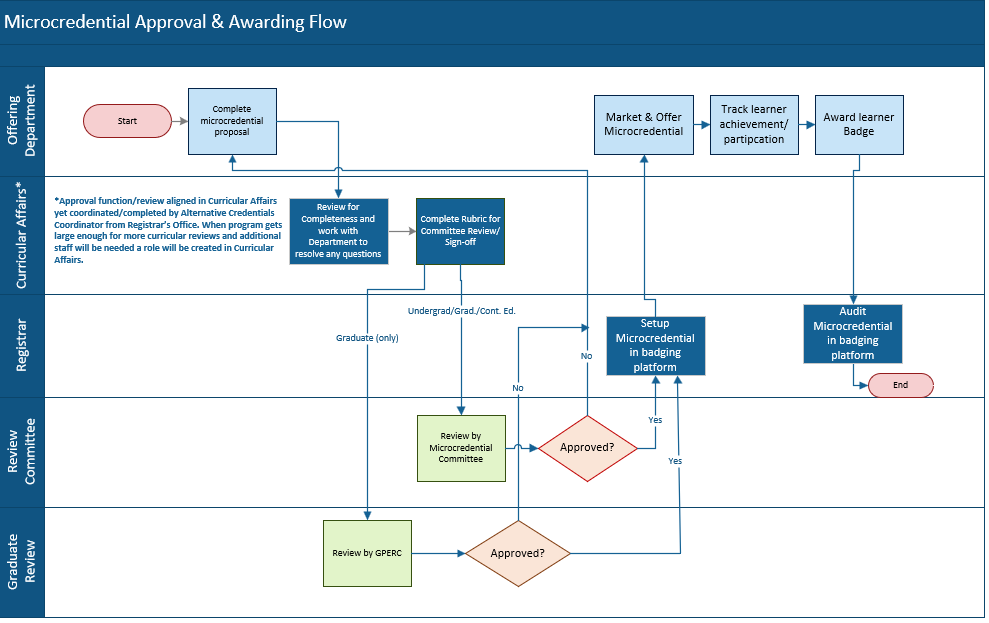
Step 7: Microcredential Approval & Awarding Flow
Digital badges are to be awarded through Credly within 14 calendar days of earning, to learners who meet required microcredential criteria. Issuing departments are responsible for ensuring compliance of badge awards. Certificates may be issued in companionship with a digital badge. To view our current Microcredential Approval & Awarding Flow.
microcredential changes & Termination
Microcredential Changes
Contact the Alternative Credential Coordinator to determine if a Microcredential Modify form is appropriate.
Microcredential Termination
To discontinue use or archive a microcredential submit a Microcredential Terminate form in Coursedog. Contact the Alternative Credentials Coordinator for Coursedog access.
microcredential committee
The Microcredential Committee serves as the governing body for microcredentials. Microcredential Proposals are reviewed to ensure that the credential:
- Has value for learners and employers
- Outcomes align with the audience
- Earning criteria are appropriate and relevant
- University mission and values are upheld
The Microcredential Committee is chaired by the Alternative Credential Coordinator. Members consist of faculty and student-supporting staff of the University of Arizona. The committee meets during the academic year on a 5-week cadence.
badge taxonomy
Digital Badge Categories Offered by the University of Arizona
Verified
Competency

Competency verified by
assessment. Minimum
of 80% required.
Background color changes
from (1) Azurite, (2) Cool Gray,
(3) Sky, (4/only) Arizona Blue.
Arizona Red for Pathway Uber
badge only.
Verified
Competency:
U of A
Community
Programs

Competency verified by
assessment. Minimum
of 80% required.
Background color changes
from (1) Azurite, (2) Cool Gray,
(3) Sky, (4/only) Arizona Blue.
Arizona Red for Pathway Uber
badge only.
Engagement:
Wildcat
Journey

Experiential learning.
Absent of competency
assessment.
None
MicroCredential & Digital Badging Policies
Scope
This policy applies to all electronic badges issued by The University of Arizona. This policy does not preclude other forms of recognition or awards. If uncertainty exists, contact Erin Riesgo, Alternative Credentials Coordinator (eriesgo@arizona.edu).
Microcredentials and Digital Badge Issuance
- Microcredentials and digital badges themselves are non-credit-bearing.
- Digital badges are associated with learning demonstrated through University of Arizona learning activities.
- The University of Arizona will not award digital badges for any course, program, or experience in which University of Arizona faculty/staff do not assess completed work.
- The University of Arizona does not badge participation or milestones.
- All issuance of microcredentials from the University of Arizona are managed and overseen by the Office of the Registrar. As such, the creation of digital badges is conducted and managed by the Alternative Credentials Coordinator, a member of the Office of the Registrar. Digital badges issued by the university are considered to be an official credential of an individual.
- Once issued, badges are controlled by the learner, though information about or within them be updated or, in some cases, revoked, as needed
Need Help? Contact Us!
Please contact the Office of the Registrar at badge@arizona.edu with any questions regarding microcredentials and badges.
revised 9/2026