


Gain new skills, knowledge, and experience with Microcredentials
What is a Microcredential?
A microcredential is a small program in a focused area of study. When completed, microcredentials provide a way to demonstrate acquisition and competence of specific skills, knowledge or vocational training to meet employers’ workforce needs. They can function within existing degree programs or as non-credit programs. Those that bear credit are typically 6 - 12 credits, which is fewer credits than degrees and certificates. When a student fulfills the requirements for a microcredential, they will receive an electronic badge that can be shared with employers.
Benefits of earning Microcredentials
Learners and professionals can distinguish themselves by achieving a proficiency in skills that enhances their knowledge and marketability in the workplace. Microcredentials can be “stacked” or combined with credentials from other sources allowing recipients to build their microcredentials into larger, more recognizable credentials. For example, robotics and machine learning microcredentials could be stackable into a larger Artificial Intelligence credential. Microcredentials can be offered online, on-campus, or via a hybrid of both.
What is a Digital Badge?
At the successful completion of a microcredential program, learners are awarded a digital badge. Digital badges are artifacts, much like a diploma, of the skills mastered after completing a microcredential program. Open badges contain metadata about the program’s requirements and learning objectives. They are independently verifiable and portable, thus empowering learners to use and share as they see fit.
How does a Microcredential differ from a Certificate?
Microcredentials differ from traditional degrees and certificates in that they are generally offered in shorter or more flexible timespans and tend to be more narrowly focused. Microcredentials provide a way to demonstrate acquisition and competence of specific skills, knowledge or vocational training to meet employers’ workforce needs. They can function within existing degree programs or as a part of a certificate. Certificates typically have a minimum number of credits, and are smaller than major programs of study. Completed certificates are typically recorded on academic records and displayed on traditional transcripts.
Frequently Asked Questions
Microcredentials are available to degree seeking and non-degree seeking learners, undergraduates, graduates, non-traditional learners and working professionals. Except for graduate-level microcredentials, which require a bachelor’s degree, it is not necessary to have a college degree to apply. Some credentials have prerequisites. Admission is not required for enrollment.
Microcredential participation does not confer University of Arizona student or alumni status and will not appear on a transcript.
One of the most unique features of a University of Arizona digital badge is the ability to easily communicate accomplishments. Learners can share thei badge with social media sites or incorporate them on their professional branding tools like a resume or website. UA Badge-Earners Support.
A digital badge is a visual, online representation of an accomplishment, skill or other achievement. Open badges are a type of digital badge.
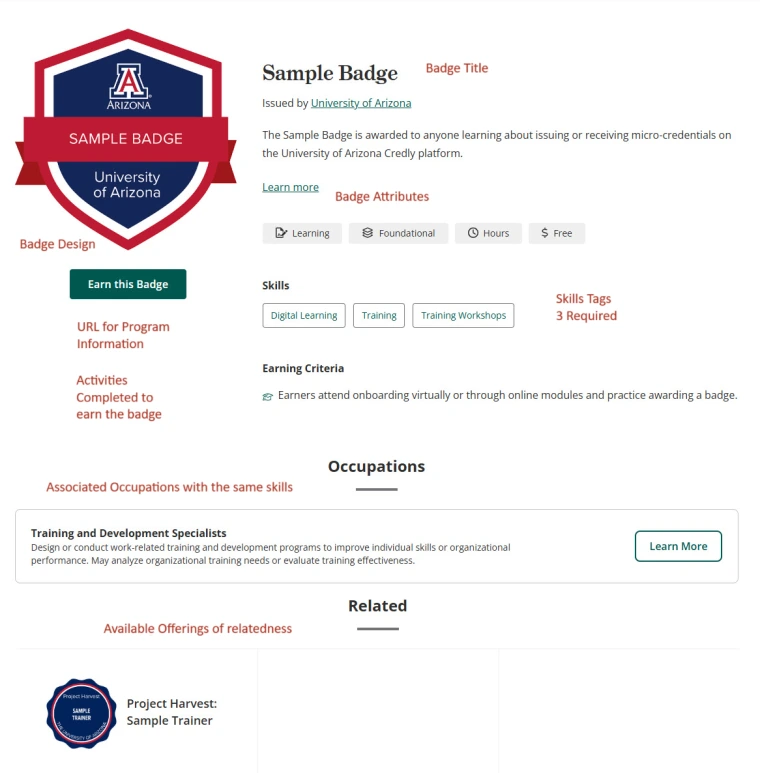
Microcredentials are offered in the classroom / face-to-face, online or a hybrid of both.
Microcredentials are not-for-credit, but may be awarded concurrently when enrolled in a credit class. Some microcredentials may require an activity or have requirements apart from credit-earning classes (workshops, seminars, etc.).
A non-credit certificate is awarded by an educational institution (such as The University of Arizona) after you complete a program. Certificate programs typically involve successful completion of multiple courses. Industry certifications are awarded by a certification body (often an industry association, trade group or corporation).
Certifications are usually awarded after successfully completing an exam that demonstrates you have acquired the knowledge, skills, and abilities to perform a specific job or task. Certifications are often time-limited and may be renewed through a recertification process.
How Academic Units Issue Microcredentials and Digital Badges
The Microcredential Proposal form is available directly in the academic catalog platform, Coursedog, simplifying the submission and approval process.
Learn more in the linked resource guide that outlines:
- Microcredential Proposal Submission, Approval, Marketing and Awarding
- Microcredential Changes & Termination
- Microcredential Review Committee
- Badge Taxonomy
- Mirocredential & Digital Badging Policies
For questions regarding the process contact the Alternative Credentials Coordinator, Erin Riesgo.
Microcredentials in the News
92% of US Employers Willing to Offer Higher Starting Salaries to Graduates with Microcredentials
Should I get microcredentials to complement my 4-year degree in today's job market?
SHRM Report: Survey Finds a Rise of Alternative Credentials in Hiring
Giving Students a Leg UP with Job Skills a Resume Won't Show
Small But Mighty: Why Microcredentials Are Huge for the Future of Work